

NZSA Disclaimer
$17,878[1].
That is the current value of the NZ Super Fund (NZSF) attributable to every person in New Zealand, a staggering $95.9 billion. In only 25 years, the Fund has demonstrated the value of a long-term approach to national saving.
But the Fund was created to smooth the rising cost of NZ Super between generations, not eliminate it entirely. Completing the job will require difficult decisions about NZ Super, KiwiSaver and private saving.
Despite its success, we shouldn’t get too carried away just yet; Norway, with a similar population to New Zealand, has a sovereign wealth fund approximately 40 times larger than the NZ Super Fund, or around NZ$715,000 per person, funding 27% of its government spending. To be fair, Norway’s petroleum wealth makes it an exceptional case, rather than a model New Zealand could easily replicate.
But back to New Zealand.
The NZSF was established by the NZ Superannuation and Retirement Income Act 2001, championed by the late Sir Michael Cullen. The Fund’s key purpose is simple: to improve the ability of future governments to pay for NZ superannuation. The same Act that established the Fund also established the Guardians of New Zealand Superannuation.
And given the capricious nature of the political winds that have blown across Wellington since 2001, we should be very thankful for the Guardians. Not only are they appointed via an independent nominations committee, they have full operational independence from our politicians, meaning that the Government cannot simply take that $17,878 and distribute it to every New Zealander for a short-term sugar hit. Nor can the Government take the money and use it for any other purpose.
Independence is not the only strength of the NZSF.
With the first significant withdrawals not expected until the 2050s, the investment horizon attached to NZSF is much longer than the typical funds available to most investors. That means the Fund can ‘look through’ any short-term volatility. Also, its sovereign status makes it an attractive investment partner in joint ventures or other investment opportunities.
For NZSF, the relationship of contributions (or withdrawals) is set by a formula enshrined in the Act (and conveniently available in Excel form on Treasury’s website[2]).
Controversially, the Government decided to halt contributions to NZSF between 2009-2017. The Fund measured the value loss of that decision at $28.6 billion as at June 2022. After 4 years of strong returns since then, my own approximate calculations show that the net opportunity cost is now likely to be between $40 – $47 billion.
This mirrors the same decisions made on a smaller scale by households across New Zealand in making spending versus saving decisions. Whatever is spent for consumption now will have a compounding effect on retirement lifestyle in future.
Performance
It helps that the performance of the fund has been very strong over the 20+ year period it has been in existence. Its FY25 Annual report highlighted a 10.09% pre-tax return since inception, compared with a long-term expectation of 7.8%.
The Fund also discloses monthly figures, showing that in the 11 months to May 2026, its value had increased by a further $9 billion (from $85 to $94 billion). That points to another strong year of returns for the NZSF. We’ll know more as the Fund’s Annual Report is issued for the year to June 2026 over the next month or two, but the fund is likely to remain one of the best-performing sovereign wealth funds in the world.
That success is important, but it should not obscure the scale of the problem the Fund was designed only partly to address.
The challenge
NZSF was established to improve the Government’s ability to pay NZ Superannuation. But it was never aimed at creating enough wealth to fully fund the annual requirement. The objective is simply to ‘smooth’ the increase in superannuation costs between generations.
Regardless of whether NZSF is there or not, the cost of superannuation in relation to the size of our economy (GDP) is increasing.
Treasury’s 2025 Statement on Long-term Fiscal Position[3] notes that “the most significant long-term spending pressures come from a combination of healthcare and New Zealand Superannuation (NZS)”. Treasury notes that the current superannuation expenditure of 5.1% of GDP would increase to between 7.8% – 8.0% by 2065. With withdrawals from NZSF expected to commence in 2055, that reduces to approximately 7.3%. It is noteworthy that the estimate excludes the impact of the tax paid to the Government by NZSF as a result of its investing activity. If this is included, the percentage is likely to fall further.
Treasury has considered three scenarios:
- increasing NZ Super payments only by inflation (CPI) each year (they are currently wage-linked, with CPI protection)
- increasing the age of eligibility to 68 years, with a one year increase in each of 2030, 2035 and 2040
- means testing, with an abatement applied at $0.40 per dollar over $10k or $60k in earnings
Each comes with trade-offs. While index-linked CPI would stabilise NZ Super at current levels of GDP, this would result in pensioner households being worse off. Linking to CPI and increasing the age of eligibility would likely encourage an individual ‘self-help’ response, boosting KiwiSaver and personal investment approaches. Means testing is likely to discourage this, as the reward from personal effort results in reduced income for the individual.
No silver bullet
New Zealand has the beginnings of a strong foundation when it comes to superannuation affordability. Universal superannuation, KiwiSaver and the NZ Super Fund create a strong baseline for how we can structure our collective retirement over the next 100 years. But as noted by Treasury, “these would need to be significantly expanded in line with reforms to NZS to make much of a dent in the future fiscal cost of pensions.”[4]
For KiwiSaver, it is great to see the proposals by the Government to offer a $1,500 Government contribution to the KiwiSaver accounts of every newborn. It isn’t enough, but at least it’s a step in the right direction. The first of a stepped increase in KiwiSaver contributions is helpful also, acting to support New Zealand’s collective retirement savings in the long-term. This also encourages some degree of ‘self-determination’ when it comes to retirement saving, supporting positive behavioural responses to both savings and investor capability.
The discussion is now moving towards KiwiSaver compulsion. This is both a blessing and a curse: while helpful for the national interest, it has the potential to create short-term hardship amongst those who will benefit most in the long-term. My hope is that this is recognised as two separate issues: one being long-term retirement savings, while the second is a short-term welfare issue. They should not be conflated.
There is a fourth leg to New Zealand’s retirement savings, and that is personal investments or savings held outside KiwiSaver. Australia has shown us the wealth impact of encouraging self-management of superannuation, with approximately $1.1 trillion now attributed to self-managed schemes (out of the total $4.5 trillion in superannuation savings). While expensive in the short-term, thanks to the tax incentives that support savings, this also incentivises a positive long-term behavioural response towards retirement savings.
Australia
The comparison with Australia is instructive for New Zealand. A combination of superannuation savings schemes, limited-access government-funded superannuation and self-managed super schemes forms a system-wide approach that results in Australia’s net superannuation costs forecast to remain constant as a percentage of GDP, improving affordability into the long-term.
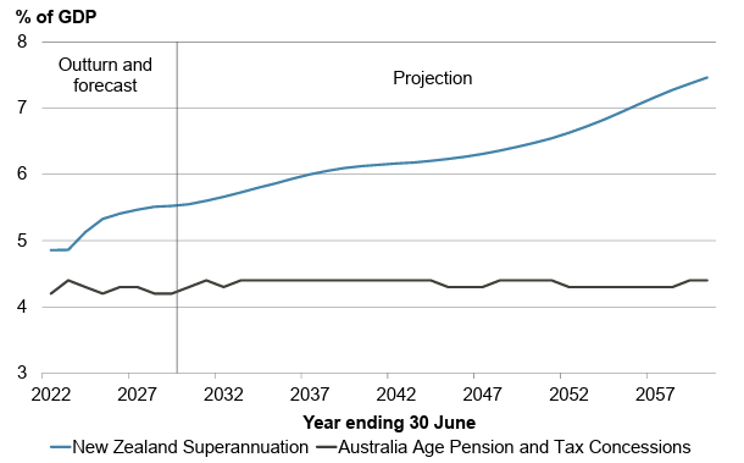
Figure 37: Pension expenditure in Australia and New Zealand, from Treasury He Tirohanga Mokopuna 2025 Long-term Fiscal Update
New Zealand is clearly at an inflection point in how it supports superannuation in future. The conversation started with the establishment of the NZ Super Fund 25 years ago; Sir Michael Cullen’s legacy has already been judged kindly by history.
But it still represents a job only half done. The hard decisions around KiwiSaver, NZ Superannuation payments and personal savings and investments are yet to come.
Nonetheless, NZ Super Fund has shown the way, forming an exemplar for how individual households can think about the balance between their own short-term living costs and long-term savings. It also creates the ability for a ‘soft-landing’ for any transition in New Zealand’s superannuation approach.
Its real value is not just in the funds it manages and the returns it generates; it is in the optionality it provides to create a sustainable superannuation future.
[1] Calculation from Stats NZ population clock, NZ Super Fund website
[2] New Zealand Superannuation Fund Contribution Rate Model – BEFU 2024 | The Treasury New Zealand
[3] https://www.treasury.govt.nz/publications/ltfp/he-tirohanga-mokopuna-2025
[4] https://www.treasury.govt.nz/publications/ltfp/he-tirohanga-mokopuna-2025
Oliver Mander