

If you’re not yet a member, join now for access to a whole lot more!
12 April 2026
Summerset Group Holdings Ltd (SUM)
Meeting Date: Tuesday, 21 April 2026 at 2:30pm.
Venue: Mākaro Room, Ground Floor, Wharewaka Function Centre, Taranaki Wharf, 2 Taranaki Street, Waterfront, Wellington.
You can also join the meeting online at this link.
Company Overview
The company has 44 retirement villages either completed or under development in New Zealand and Australia, comprising 7,198 retirement units and 1,475 care beds. It has over 9,500 residents and over 3,200 staff. It also has a landbank equivalent to 5,499 retirement units and 1,173 care beds. The company holds the largest land bank of units in the sector and is the second largest operator.
Current Strategy
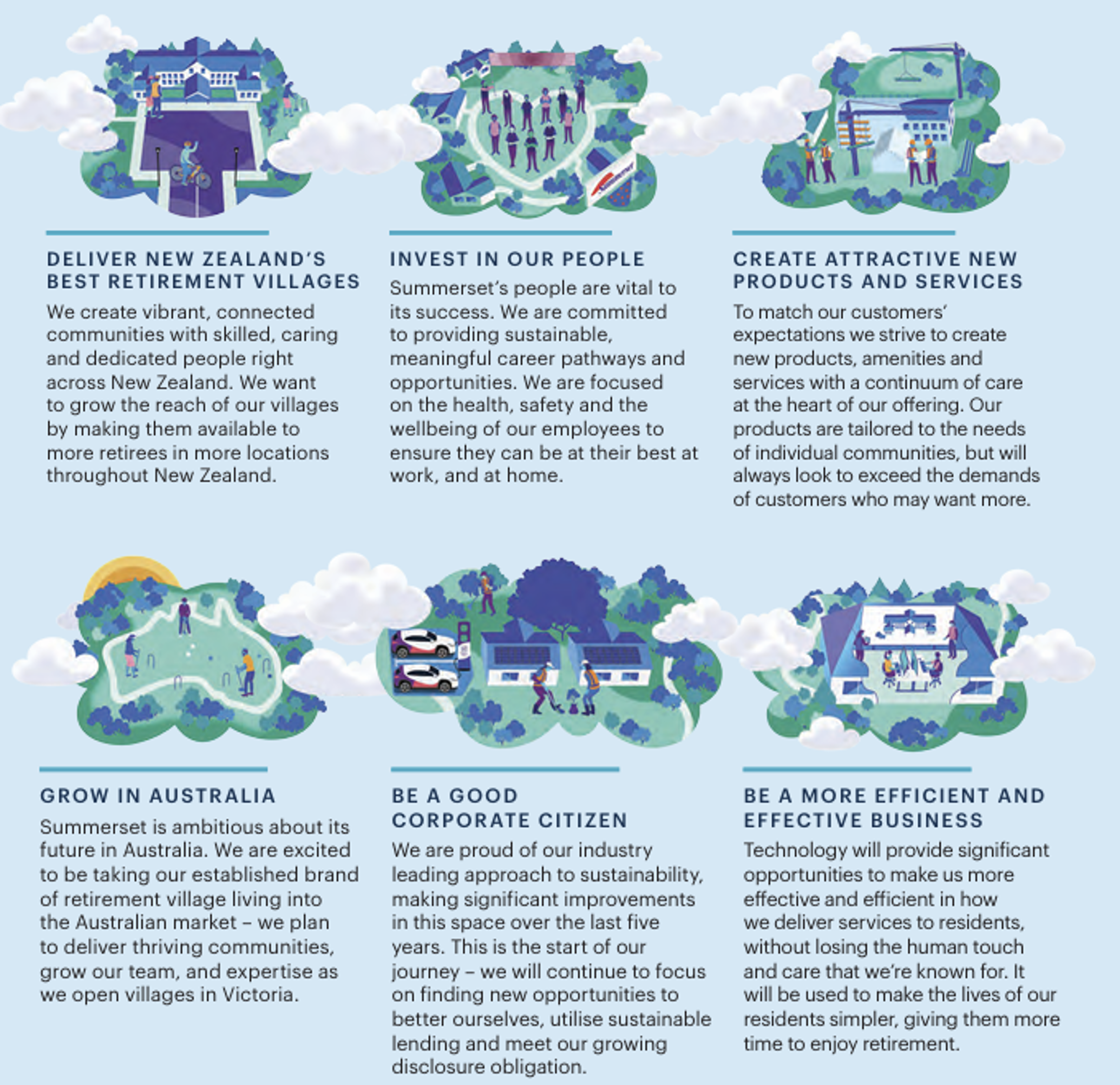
The company develops, designs, constructs, and operates retirement villages and care centres in New Zealand and Australia, with a strategy focused on six core pillars:
Previous Year Shareholder Meeting
NZSA recorded the following key items at last year’s annual shareholder meeting:
- The market conditions are challenging, and Summerset is continually setting its build programme to meet the market.
- It’s difficult to make an even modest return on investment on their care bed offerings as they are constrained as to what they can charge by government contract (even for private clients).
- The company has a considerable land bank.
The meeting report is available at this link.
Disclaimer
To the maximum extent permitted by law, New Zealand Shareholders Association Inc. (NZSA) will not be liable, whether in tort (including negligence) or otherwise, to you or any other person in relation to this document, including any error in it.
Forward looking statements are inherently fallible.
Information on www.nzshareholders.co.nz and in this document may contain forward-looking statements and projections. For any number of reasons, the future could be different – potentially materially different. For example, assumptions may be wrong, risks may crystallise, unexpected things may happen. We give no warranty or representation as to any future financial performance or any other future matter. We may not update our website and related materials for changes.
There is no offer or financial advice in our documents/website.
Information included on www.nzshareholders.co.nz and in this document is for information purposes only. It is not an offer of financial products, or a proposal or invitation to make any such offer. It is not financial advice and does not take into account any person’s individual circumstances or objectives. Prior to making any investment decision, NZSA recommends that you seek professional advice from a licensed financial advice provider.
There are no representations as to accuracy or completeness.
The information, calculations, and any opinions on www.nzshareholders.co.nz and in this document are based upon sources believed reliable. The NZSA, its officers and directors make no representations as to their accuracy or completeness. All opinions reflect our judgement on the date of communication and are subject to change without notice.
Please observe any applicable legal restrictions on distribution
Distribution of our documents and materials on www.nzshareholders.co.nz (including electronically) may be restricted by law. You should observe all such restrictions which may apply in your jurisdiction.
Key
The following sections calculate an objective rating against criteria contained within NZSA policies.
|
Colour |
Meaning |
|
G |
Strong adherence to NZSA policies |
|
A |
Part adherence or a lack of disclosure as to adherence with NZSA policies |
|
R |
A clear gap in expectations compared with NZSA policies |
|
n/a |
Not applicable for the company |
Governance
NZSA assessment against its key policy criteria are summarised below.
|
G |
Directors Fees: Excellent disclosure. NZSA notes that an initially proposed resolution to increase director fees over two years has been withdrawn from consideration, mainly due to economic risks associated with current geopolitical considerations. This reflects a prudent approach to director fees and their alignment with company cost escalation risks.
|
G |
Director Share Ownership: We note that Directors “are required to acquire and hold shares in the Company to the value of one year’s worth of director fees, though the Board has the ability to waive this requirement and would do so in the appropriate circumstances. They have two years in which to acquire the shares.” NZSA encourages directors to hold shares in the companies they govern – however, compulsion to do so is not generally supported by NZSA.
For Summerset, Directors have two years in which to meet the requirements, representing 50% of their income (pre-tax) for each of two years. While encouraging long-term remuneration, this requirement would preclude the appointment of Directors who lack the personal wealth to fulfil that requirement and may also affect their independence. In mitigation, we note the ability of the Board to waive this requirement.
NZSA recognises a significant level of personal ownership may be appealing to some investors.
|
G |
CEO Remuneration: The company discloses its remuneration policy on its website, which includes an overview of the remuneration philosophy applicable to the company. The People and Culture Committee are responsible for implementing the policy.
Incentives: The CEO is paid short-term incentive (STI) in cash and a long-term incentive (LTI) by way of share options
NZSA encourages fulsome disclosure in relation to any incentive payments made to the CEO, including disclosure of measures (or measure ‘groups’), weightings, targets, and the level of achievement versus target for each component associated with any awards. This methodology is supported by the NZX Remuneration Reporting Template.
The STI is awarded at a target of 50% of base salary with a maximum opportunity of 155% of target equal to 77.5% of base salary. The measures, weightings, and level of achievement against each component are well-disclosed, with the overall STI award being made at 89% of the maximum.
Zero-priced share options are awarded under the LTI at 60% of base salary. Vesting then occurs after a three-year performance assessment period. The measure is total shareholder returns, both absolute and relative. The structure is favoured by NZSA as it aligns the interests of the CEO with that of shareholders.
NZSA prefers a weighting towards the LTI to ensure the CEO is aligned with the interests of long-term shareholders.
The CEO is required to hold shares equivalent to one year’s base salary.
The company is one of few that discloses both the gender pay gap and CEO/employee remuneration ratio.
Golden Parachutes: In the interests of transparency, NZSA believes there should be explicit disclosure around the severance terms and notice periods associated with the CEO, including whether specific termination payments are offered. In previous years this has been disclosed, and we would encourage the company to revert to disclosure in future Annual Reports.
|
G |
Director Independence: All Directors are independent.
|
G |
Board Composition: The Annual Report includes a skills matrix that attributes skill sets to individual Directors to demonstrate how they contribute to the governance of the company. The company is one of few that participates in the IoD’s Future Director programme designed to develop and mentor the next generation of Directors. NZSA expect NZX50 companies to participate as part of a responsibility to develop and mentor the next generation of Directors.
|
G |
Director Tenure: NZSA looks for evidence of ongoing succession or ‘staggered’ appointment dates that reduce the risks associated with effective knowledge transfer in the event of succession. We also prefer a term maximum of 9-12 years, unless there are exceptional circumstances that may apply.
Dr Marie Bismark has served since September 2013. She stood for re-election at the 2024 ASM and the Notice of Meeting indicated this will be her last term. The Notice also acknowledged her long tenure and gives good reasons for this. NZSA appreciates this disclosure. Grainne Trout has served since September 2016. At the 2025 ASM she indicated that she would retire during her current term. Other Directors were appointed between 2017 – 2023.
|
G |
ASM Format: Summerset Group Holdings Ltd is holding a ‘hybrid’ meeting, (i.e., physical, and virtual), a format preferred by NZSA as a way of promoting shareholder engagement while maximising participation.
|
G |
Independent Advice for the Board & Risk Management: NZSA looks for evidence, through disclosures, that a Board has access to appropriate internal and external expertise to support board assurance activities.
There is good disclosure in the Annual Report around the extent to which Board members can seek external or internal advice to support decision-making, and the extent to which internal assurance staff have unfettered access to the Board. The Board appointed KMPG as internal auditor in 2016 to manage the internal audit function.
The company offers good disclosure of financial, business, and operational risks, their mitigations, and the processes by which these are governed. As well as the disclosures in the Annual Report the company has published a 61-page Sustainability Report including Climate Change disclosures.
Audit
NZSA assessment against its key policy criteria are summarised below.
|
G |
Audit Independence: Good disclosure.
|
G |
Audit Rotation: The company ensures the Lead Audit Partner is rotated at 5 years as required by the NZX Listing Rules. PwC were appointed Auditor in 2025 replacing EY who were appointed in 2004 and reappointed in 2017 following a tendering of the role. We would encourage the disclosure of the appointment date of the Audit Firm and the appointment and rotation date of the Lead Audit Partner in the Annual Report.
Environmental Sustainability
Overall approach: From an NZSA perspective, Summerset remains one of the stronger climate reporters among NZX-listed companies, with FY25 disclosures prepared in accordance with the New Zealand Climate Standards. Climate considerations remain embedded within Summerset’s ten-year strategic plan and sustainability framework, guiding operational and investment decisions. Similar to the previous year, the company continues to pursue operational decarbonisation initiatives, including transitioning villages away from gas, expanding renewable energy generation through solar deployment, and reducing embodied carbon in construction activities. These initiatives demonstrate continued progress in reducing emissions intensity while strengthening operational resilience and supporting the company’s long-term sustainability strategy.
Sustainability Governance: Summerset board retains oversight of climate matters, with the Audit and Risk Committee responsible for reviewing climate-related disclosures and monitoring risk management processes. The company also maintains a Director Skills Matrix that includes “Environmental and social” capability. Overall, governance arrangements appear largely consistent with those disclosed in FY24, indicating continuity in oversight and accountability structures.
Strategy and Impact: The company’s Climate Action Plan outlines key decarbonisation initiatives, including transitioning villages off utility gas by 2028, expanding solar energy generation, and improving building design to reduce embodied carbon. The company is also embedding climate resilience into village design and operational planning, recognising the need for communities to remain functional during extreme weather events.
Risk and Opportunity: Summerset discloses both physical and transition climate risks within its climate report and incorporates these risks into its enterprise risk management framework. Climate scenario analysis is undertaken to assess the potential impact of different climate pathways on the business, supporting strategic planning and risk mitigation. As in the previous year, the company also identifies opportunities associated with the transition to a lower-carbon economy, including renewable energy generation, improved building efficiency and reduced embodied carbon in construction materials. Climate risks continue to be considered in land acquisition decisions and long-term village planning.
Metrics and Targets: Summerset reports Scope 1, Scope 2 and Scope 3 greenhouse gas emissions, supported by multi-year comparative data that allows investors to monitor emissions performance over time. A key target remains the company’s science-based goal to reduce Scope 1 and 2 emissions intensity by 49% by 2028, using FY22 as the baseline, with the company reporting ongoing progress toward this target during FY25. Operational indicators such as renewable energy generation, solar deployment and construction waste diversion continue to be tracked and publicly reported.
Assurance: Summerset’s greenhouse gas disclosures continue to be subject to independent limited assurance. As in previous years, the use of external verification strengthens investor confidence in the accuracy of the company’s reported environmental performance and its alignment with the New Zealand Climate Standards framework.
Ethical and Social
NZSA assessment against its key policy criteria are summarised below.
|
G |
Whistleblowing: Good disclosure.
|
G |
Political Donations: No donations are made.
Financial & Performance
|
Policy Theme |
Assessment |
|
Capital Management |
G |
|
Takeover or Scheme |
n/a |
Summerset’s share price fell from $12.39 to $10.10 (as of 10th March 2026) over the last 12 months – an 18% decrease. This compares unfavourably with the NZX 50 which rose 5% in the same period. The capitalisation of SUM is $2.4b placing it 22nd out of 114 companies on the NZX by size and makes it a large company.
|
Metric |
2021 |
2022 |
2023 |
2024 |
2025 |
Change |
|
Revenue |
$205.3m |
$238.7m |
$272.2m |
$319.9m |
$362m |
13% |
|
Fair Value Movement |
$540.9m |
$268.8m |
$441.6m |
$372.6m |
$266m |
-29% |
|
NPAT |
$543.6m |
$225.4m |
$436.3m |
$339.8m |
$259.7m |
-24% |
|
EPS1 |
$2.36 |
$1.16 |
$1.86 |
$1.435 |
$1.072 |
-25% |
|
PE Ratio |
5 |
8 |
6 |
8 |
9 |
|
|
Capitalisation |
$2,687m |
$2,019m |
$2,682m |
$2,552m |
$2,448m |
-4% |
|
Current Ratio |
0.16 |
0.24 |
0.29 |
0.29 |
0.21 |
-27% |
|
Debt Equity |
1.56 |
1.66 |
1.66 |
1.72 |
1.78 |
3% |
|
Operating CF |
$383m |
$369m |
$398m |
$443m |
$448m |
24% |
|
NTA Per Share1 |
$8.33 |
$9.42 |
$11.08 |
$12.50 |
$13.72 |
10% |
|
Prem/Disc to NTA |
40% |
-8% |
3% |
-14% |
-26% |
n/a |
|
Dividend |
$0.183 |
$0.223 |
$0.245 |
$0.245 |
$0.245 |
n/c |
1 Based on shares on issue as at balance date
Operating revenues continue to improve for Summerset, up another 13% to $362m, yet the company did have difficulties during 2025 and many metrics, including the share price declined. NPAT declined, down 24% to $259.7m which interestingly is very similar to the disproportional effect of “Fair value movement of investment properties” which accounted for $266m, down on last years $372.6m.
This seems to indicate that most of the profit drivers are the value change in properties, rather than any operational performance. Summerset can be classed firstly and foremost as a property company; the provision of aged care being an afterthought. (The caveat, we do note that revenues continue to rise, but these are offset by operating costs)
The Debt-to-Equity ratio rose slightly to 1.78. Interest bearing debt continued to increase, up by $257m to $1.97b. SUM will have to watch debt levels carefully, however as interest rates decline, the short-term impact of higher debt will be mitigated. That all said, finance costs did rise 22% to $32m.
Operating Cashflow shows how well the company is performing on an operational level. For Summerset, it increased by 24% to $548m, a healthy figure and when expressed in EPS comes in at $2.26.
The NTA of SUM continued to increase and is $13.72. SUM trades at a largish 26% discount to NTA, and is more in line with market peers.
NZSA would like to see SUM (and others in the sector) provide a clearer view in their Statement of Financial Position between ‘current’ and ‘non-current’ assets and liabilities.
Dividends remained steady at $0.245. Dividends are currently not imputed. Due to the nature of their business the company pays little to no tax on their profit. SUM may consider alternative means of capital management to maximise shareholder value, although we note that the dividend is low when related to EPS and their share price.
In conjunction with their annual results, Summerset provided a detailed investor presentation, but did not provide any forward looking financial projections, however are projecting NTA growth on completion of village construction.
The company is held by a variety of institutions and the top 20 shareholders hold a collective 75.98% of Summerset.
Resolutions
1. That the Board is authorised to fix the auditor’s remuneration for the coming year.
This is an administrative resolution.
We will vote undirected proxies IN FAVOUR of this resolution.
2. To re-elect Dr Andrew Wong as an Independent Director.
Dr Andrew Wong was appointed to the Board 1 March 2017. He is the Managing Director of Allevia Health, a private healthcare investment company. He qualified as a specialist medical practitioner with a Master’s in Public Health, and with a Fellowship of the New Zealand College of Public Health Medicine. He has extensive experience in strategic planning and implementation, business development, leadership, and operational management. This has been gained over a 30-year career in public and private health both in New Zealand and overseas. He is a director of a number of companies through his Allevia Health role. These include Auckland Radiation Oncology, Allevia hospitals, Kensington Hospital and Allevia Radiology. Other present and past directorships include companies providing services in the areas of interventional cardiology, cancer care, healthcare property development, medical supplies, day and inpatient surgery and endoscopy, and veterinary medicine. He has held government appointments with Health Workforce New Zealand and the Health Innovation Hub, as well as sitting on the Executive of the New Zealand Private Hospitals Association and as an Adjunct Professor of AUT. The Notice of Meeting notes If reappointed, it is intended that this will be his final term.
We will vote undirected proxies IN FAVOUR of this resolution.
3. To re-elect Venasio-Lorenzo (Vena) Crawley as an Independent Director.
Venasio-Lorenzo (Vena) Crawley was appointed to the Board 1 February 2020. He has career experience in multiple sectors that include banking & financial services, oil & energy, health, education, and retail. He is an independent director at Orion NZ, Variety Children’s Charity and Southern Cross Health Society, a member of the Institute of Directors Pacific Governance Advisory Board, and Chair of the AUT Business School Industry Advisory Board. He also completed a term as a Future Director for The Warehouse Group. Vena completed his executive career as the Chief Customer Officer at Contact Energy with the successful turnaround of their Retail, LPG, Broadband, and Commercial and Industrial businesses. He retired from that role in April 2021. He has international experience working in the United Kingdom, Australia and NZ markets and has diverse skills in profit growth strategy, transformation, technology, digital, data monetisation, operations, logistics, marketing, and his passion – customer experience.
We will vote undirected proxies IN FAVOUR of this resolution.
4. To re-elect Fiona Oliver as an Independent Director.
Fiona Oliver was appointed to the Board 1 March 2023. She is an experienced professional director with a governance career spanning a variety of sectors, including renewable energy, natural gas, technology, commercial property, financial services, professional services, and sport. These roles, ranging from Board Member to Audit & Risk Committee Chair, have been in commercial, public sector and not-for-profit entities. Fiona’s current directorships include Freightways (NZX), Gentrack (NZX/ASX), three Fisher Funds (NZX) entities, Clarus (formerly First Gas group), and the New Zealand Superannuation Fund. Fiona was also previously on the board of Wynyard Group Limited (in liquidation). The Board regularly reviews Director commitments and believes that Fiona’s current portfolio of roles allows her to remain fully engaged and effective in her oversight of the Company. Fiona has advised that two of her existing external roles are anticipated to conclude during the proposed term, which will further support her ongoing capacity to fulfil her duties as a Director. Fiona has held Executive leadership roles in funds management for Westpac (BT Funds Management) and AMP in New Zealand. She has also held commercial roles in asset management and private equity in Sydney and London. Prior to her management career, Fiona practised as a senior corporate and commercial lawyer in New Zealand and overseas, specialising in mergers and acquisitions.
We will vote undirected proxies IN FAVOUR of this resolution.
Proxies
You can vote online or appoint a proxy at https://vote.cm.mpms.mufg.com/SUM/
Instructions are on the Proxy/voting paper sent to you.
Voting and proxy appointments close 2.30pm Sunday 19 April 2026.
Please note you can appoint the Association as your proxy. We will have a representative attending the meeting.
The Team at NZSA